English
 中文
中文 日本語
日本語 한국어
한국어 français
 Deutsch
 Español
 italiano
 русский
 português
 العربية
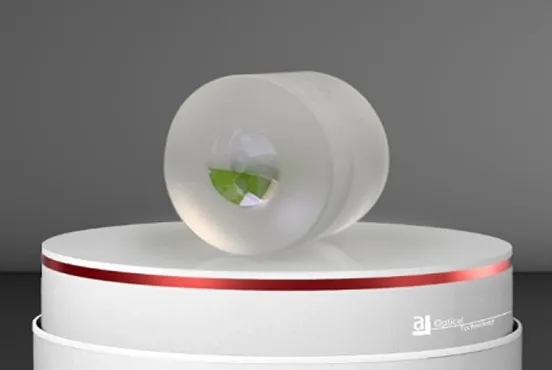
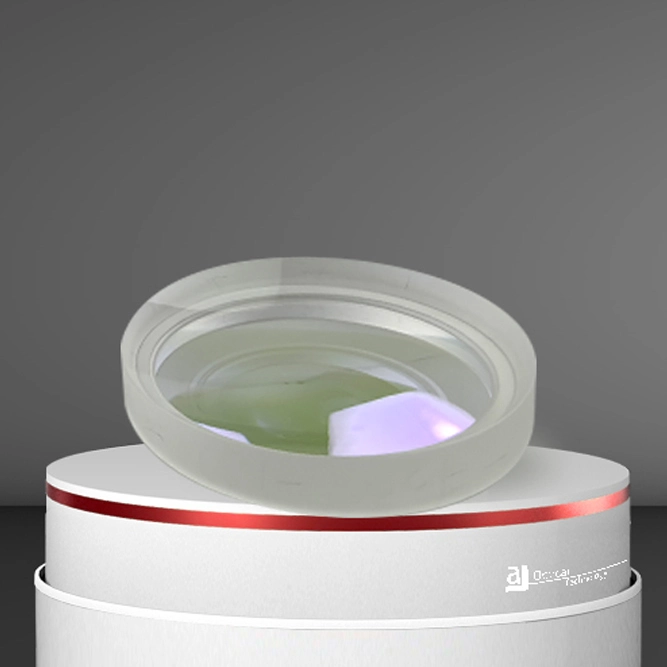
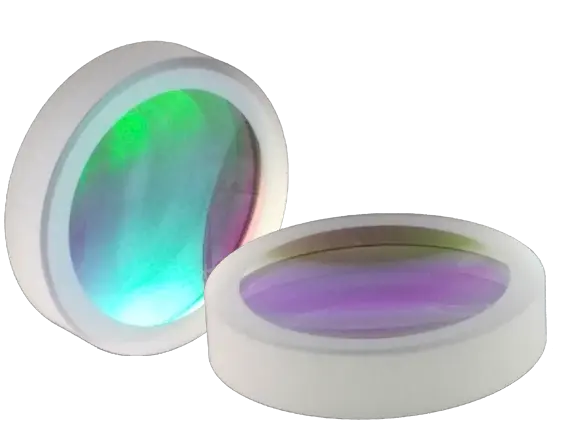
Spherical lenses are among the most widely used optical components for focusing, collimating, expanding and imaging light. Their surfaces are formed from sections of a sphere, giving them a constant radius of curvature across the usable aperture.
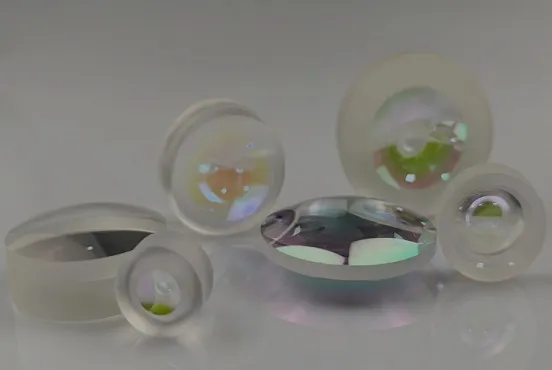
The six main spherical singlet forms are plano-convex, double-convex, positive meniscus, plano-concave, double-concave and negative meniscus lenses. The first three spherical lens types normally have positive optical power and converge light, while the last three normally have negative optical power and diverge light.
Selecting the correct lens requires more than deciding between a convex spherical lens and a concave spherical lens. Engineers must also consider object and image distances, wavelength, focal length, aperture, field of view, material, coating and acceptable aberration.
| Spherical Lens Types | Surface Shape | Optical Power | Main Function | Common Application Direction |
|---|---|---|---|---|
| Plano-Convex Lens | One flat and one convex surface | Positive | Focuses or collimates light | Laser focusing, collimation and illumination |
| Double-Convex Lens | Two convex surfaces | Positive | Forms images between finite conjugates | Image relay, magnification and machine vision |
| Positive Meniscus Lens | One convex and one concave surface | Positive | Converges light with optimized lens bending | Imaging, focusing and aberration control |
| Plano-Concave Lens | One flat and one concave surface | Negative | Diverges or expands light | Beam expansion and focal-length modification |
| Double-Concave Lens | Two concave surfaces | Negative | Produces controlled divergence | Beam expansion and finite-conjugate systems |
| Negative Meniscus Lens | One concave and one convex surface | Negative | Diverges light while helping control aberrations | Beam correction and multi-element imaging systems |
Ball lenses and half-ball lenses also have spherical surfaces, but they are usually treated as special optical components rather than one of the six conventional spherical singlet forms. Similarly, an achromatic doublet may use spherical surfaces, but it is a compound lens assembly rather than a basic spherical lens shape.
A spherical lens is an optical element with at least one refracting surface shaped as part of a sphere. The second surface may be convex, concave or flat. A flat optical surface can be considered to have an infinite radius of curvature, which is why plano-convex and plano-concave lenses are normally included in the spherical lens category.
The curvature of each surface, refractive index of the material and center thickness determine the optical power of the lens. In conventional glass lenses used in air:
A lens that is thicker at the center than at the edge normally has positive optical power.
A lens that is thinner at the center than at the edge normally has negative optical power.
A positive lens converges paraxial light rays.
A negative lens causes paraxial light rays to diverge.
These descriptions are useful for basic identification, but the actual focal length and image performance must be calculated from the complete optical prescription.
The broadest classification divides spherical lenses into convex and concave groups.
A convex spherical lens normally has positive optical power. It redirects light toward the optical axis and can focus a collimated beam or form a real image when the object is positioned beyond the focal point.
A concave spherical lens normally has negative optical power. It redirects light away from the optical axis and causes a collimated beam to diverge as though it originated from a virtual focal point.
Within these two groups, the combination of surface shapes changes the most suitable conjugate ratio, orientation and application.
A plano-convex lens has one flat surface and one outward-curving spherical surface. It has a positive focal length and is one of the most commonly used spherical lenses for focusing and collimation.
Plano-convex lenses are particularly suitable when one conjugate is much longer than the other. Typical examples include focusing a collimated laser beam to a point or converting light from a point source into an approximately collimated beam.
Orientation matters. To reduce spherical aberration, the curved surface is generally placed toward the more collimated beam or the longer conjugate, while the flat surface faces the focal plane or shorter conjugate.
Main advantages
Simple and cost-effective geometry
Suitable for focusing or collimating light
Available in a wide range of diameters and focal lengths
Compatible with visible, ultraviolet and infrared materials
Can be supplied with broadband or laser-line coatings
Common uses
Laser focusing
Beam collimation
Illumination systems
Optical detectors
Projection equipment
Laboratory instruments
A plano-convex lens should not automatically be selected for every positive-power requirement. When the object and image distances are relatively similar, a double-convex or appropriately bent meniscus lens may provide better aberration balance.
A double-convex lens, also called a bi-convex lens, has two outward-curving surfaces. It has positive optical power and is commonly used in finite-conjugate imaging systems.
A symmetrical double-convex lens is especially useful near a 1:1 conjugate ratio, where the object and image distances are approximately equal. In this arrangement, refraction is distributed more evenly across the two surfaces than in a plano-convex lens.
The two radii do not always have to be identical. An asymmetrical double-convex design may be used to optimize aberration, focal length, thickness or mechanical packaging for a particular optical system.
Main advantages
Well suited to finite-conjugate imaging
Useful for image relay and magnification
Positive power is distributed over two surfaces
Can provide balanced performance at similar object and image distances
Available with custom material, focal length and coating options
Common uses
Image relay systems
Machine-vision optics
Magnifiers
Microscopes
Scientific imaging
Projection assemblies
Optical inspection systems
Double-convex lenses are not universal substitutes for complete photographic objectives. Wide-field or broadband imaging normally requires multiple elements to control chromatic aberration, coma, astigmatism, distortion and field curvature.
A positive meniscus lens has one convex surface and one concave surface, with the convex curvature producing greater optical power than the concave curvature. The result is a positive focal length.
The meniscus shape allows the lens to be “bent” without changing its total optical power significantly. Appropriate lens bending can reduce spherical aberration or improve off-axis performance under selected conjugate conditions.
Positive meniscus lenses are often used when a plano-convex lens does not provide sufficient performance but an aspheric lens is unnecessary or too costly.
Main advantages
Positive optical power with flexible surface bending
Can reduce spherical aberration in suitable layouts
May produce a smaller focused spot than a basic plano-convex design
Useful for modifying the performance of multi-element systems
Can support compact optical packaging
Common uses
Laser focusing
Collimation systems
Imaging objectives
Projection systems
Infrared optics
Multi-element lens assemblies
The orientation of a positive meniscus lens should be determined by ray tracing rather than by a universal rule, because performance depends on the two radii, aperture stop and conjugate conditions.
A plano-concave lens has one flat surface and one inward-curving spherical surface. It has a negative focal length and causes collimated light to diverge.
Plano-concave lenses are often used when one conjugate is effectively infinite. In laser systems, they may increase beam diameter, modify beam divergence or act as the negative element in a beam expander.
As with a plano-convex lens, orientation can affect spherical aberration. The curved surface is usually placed toward the more collimated side of the optical path when the lens is used under strongly unequal conjugate conditions.
Main advantages
Simple negative-power geometry
Predictable beam-diverging function
Suitable for beam expansion and focal-length adjustment
Available in many optical materials
Easy to integrate into laboratory and industrial systems
Common uses
Galilean beam expanders
Laser-beam divergence control
Optical testing
Projection systems
Sensor illumination
Focal-length modification in lens groups
A double-concave lens, or bi-concave lens, has two inward-curving surfaces and a negative focal length. It causes incoming light to diverge and is frequently selected when both conjugates are finite.
A symmetrical double-concave lens can provide balanced negative power when the input and output beam conditions are similar. An asymmetrical version may be designed to meet a particular divergence, thickness or aberration requirement.
Main advantages
Negative power distributed across two surfaces
Suitable for finite-conjugate divergence
Useful in beam expansion and image reduction
Custom radii can be selected for system optimization
Can be combined with positive elements to modify total focal length
Common uses
Beam expansion
Optical image reduction
Laser systems
Viewers and wide-field optical assemblies
Scientific instruments
Aberration-balancing lens groups
A double-concave lens produces a virtual, upright and reduced image when used alone with a real object. In complete optical systems, however, it is normally evaluated as part of a multi-element prescription.
A negative meniscus lens has one concave and one convex surface, with the concave surface providing the greater optical power. The lens therefore has a negative focal length.
The meniscus shape provides greater design freedom than a basic plano-concave or double-concave element. It can be used to introduce negative power while controlling spherical aberration, coma or package length within a multi-element system.
Main advantages
Negative optical power with flexible lens bending
Can help control aberrations in multi-element designs
Useful for modifying system focal length
Supports compact optical layouts
Available for visible, infrared and laser applications
Common uses
Beam expansion
Optical correction groups
Camera and imaging objectives
Projection systems
Infrared optical systems
Scientific and defense instruments
Negative meniscus lenses are often designed specifically for the surrounding optical system, so custom radii and center thickness may be more important than selecting a standard focal length alone.
Spherical lenses remain widely used because they provide a practical balance of optical performance, manufacturability and cost.
Spherical surfaces can be produced through established grinding, polishing, molding and precision-machining methods. The manufacturing process is generally more standardized than that of complex aspheric surfaces.
Spherical lenses can be manufactured from common optical glass, fused silica, sapphire, calcium fluoride, silicon, germanium, zinc selenide and other visible, ultraviolet or infrared materials.
Positive and negative spherical lenses can be combined to focus, collimate, expand, relay or correct light in a wide variety of systems.
Custom diameter, radius, center thickness, focal length, surface quality and coating can often be produced without the tooling or metrology complexity associated with advanced aspheric designs.
Radius, surface figure, centration, thickness, surface quality and coating performance can be verified using established optical metrology.
The main limitation is that a spherical surface does not bring all rays to exactly the same focal position.
Marginal rays and paraxial rays may focus at different axial locations. This can enlarge the focused spot and reduce image contrast.
Spherical aberration can be controlled by:
Choosing the correct lens form
Optimizing the surface radii
Orienting the lens correctly
Limiting the aperture
Combining positive and negative elements
Using a meniscus, achromatic or aspheric design
A single-material lens focuses different wavelengths at different positions. This can create color fringes or reduced broadband resolution.
Coma, astigmatism, field curvature and distortion become important as the field of view increases. A single spherical lens is rarely sufficient for demanding wide-field imaging.
A spherical singlet may need significant curvature or center thickness to provide high optical power. An aspheric or multi-element design may sometimes achieve the same function with a more compact form.
The following matrix shows how different spherical lens types are commonly matched to optical functions.
| Application | Required Optical Function | Common Lens Choices | Important Selection Factors |
|---|---|---|---|
| Laser Focusing | Focus a collimated beam | Plano-convex, positive meniscus | Wavelength, spot size, beam diameter, LIDT and aberration |
| Beam Collimation | Convert divergent light into a collimated beam | Plano-convex, positive meniscus | Source size, divergence, focal length and NA |
| Beam Expansion | Increase beam diameter or control divergence | Plano-concave, double-concave, negative meniscus | Expansion ratio, wavefront quality and lens spacing |
| Finite Imaging | Form an image between finite object and image planes | Double-convex, positive meniscus | Conjugate ratio, magnification, field and MTF |
| Machine Vision | Image an object onto a sensor | Double-convex or multi-element spherical assembly | Sensor size, pixel pitch, distortion and working distance |
| Microscopy | Magnify and relay fine structures | Double-convex, meniscus and compound lens groups | NA, resolution, working distance and chromatic correction |
| Projection | Form or relay an enlarged image | Positive spherical lens groups | Field size, brightness, distortion and thermal load |
| Fiber Coupling | Focus light into or out of a fiber | Ball lens, plano-convex or aspheric lens | NA matching, spot size, alignment and wavelength |
| Spectroscopy | Focus or collimate wavelength-separated light | Plano-convex, meniscus or achromatic groups | Spectral range, stray light and focal stability |
| Infrared Imaging | Focus infrared radiation | Meniscus, plano-convex or multi-element IR lenses | Material transmission, temperature and AR coating |
| Medical Instruments | Imaging, illumination or laser delivery | Multiple spherical forms | Biocompatible packaging, resolution and sterilization environment |
| Aerospace and Sensing | Imaging or beam control under demanding conditions | Material- and environment-specific lens forms | Temperature, vibration, radiation and mechanical stability |
A spherical lens is used for different functions depending on its optical power and geometry. Positive lenses normally collect or focus light, while negative lenses normally expand, diverge or correct a beam.
The material should be selected from the required wavelength range, refractive index, dispersion, thermal behavior, durability, weight and cost.
| Material | Main Characteristics | Typical Application Direction |
|---|---|---|
| N-BK7-Type Optical Glass | Good visible performance and broad availability | Imaging, instruments and general laser systems |
| Fused Silica | Strong UV performance and low thermal expansion | UV optics, lasers and scientific instruments |
| Sapphire | High hardness and environmental durability | Harsh-environment optics, sensors and aerospace |
| Calcium Fluoride | Broad UV and infrared transmission with low dispersion | Spectroscopy, UV and infrared systems |
| Silicon | Infrared transmission and high refractive index | Thermal sensing and infrared systems |
| Germanium | Strong long-wave infrared performance | Thermal imaging and infrared spectroscopy |
| Zinc Selenide | Broad infrared use and compatibility with CO₂-laser wavelengths | Thermal imaging and high-power IR laser systems |
| Special Optical Glass | Selectable refractive index and dispersion | Achromatic, compact or custom imaging systems |
Material names alone are not sufficient for a final design. Engineers should also define operating temperature, environmental exposure, internal transmission, homogeneity and availability.
Each uncoated air-glass interface reflects part of the incident light. Anti-reflection coatings reduce these losses and can improve transmission, contrast and laser efficiency.
Common coating categories include:
A general-purpose coating that reduces reflection over a moderate wavelength region. It is often used where cost and durability are more important than minimum reflectance.
A multilayer coating designed to reduce reflection across a wider spectral band, such as a visible or near-infrared imaging range.
A narrowband coating optimized for very low reflection at one specified wavelength and angle of incidence.
A coating designed for systems operating at two or more separated wavelength regions.
A coating specification should include:
Substrate material
Operating wavelength range
Angle of incidence
Polarization, when relevant
Maximum or average reflectance
Environmental durability
Laser fluence, pulse duration and repetition rate, when applicable
Writing only "AR coated" does not provide enough information for reliable coating selection.
These terms describe different aspects of an optical component and should not be treated as interchangeable lens types.
| Lens Category | Description | Main Advantage | Main Limitation |
|---|---|---|---|
| Spherical Singlet | One element with spherical or plano surfaces | Mature manufacturing and cost-effective customization | Spherical and chromatic aberration |
| Aspheric Lens | At least one surface has a changing radius of curvature | Can reduce spherical aberration and component count | More complex manufacturing and metrology |
| Achromatic Doublet | Two bonded or air-spaced elements with different dispersion | Reduces chromatic aberration over a broader band | More interfaces, alignment requirements and cost |
| Multi-Element Objective | Several lens elements optimized as a system | Controls multiple axial and off-axis aberrations | Greater design, assembly and tolerance complexity |
An achromatic lens may contain spherical surfaces, but it is not one of the six basic spherical singlet shapes. Likewise, a ball lens is a special spherical component, while an aspheric lens belongs to a different surface-geometry category.
Selecting the right spherical lens starts with defining the required optical function. Positive lenses, including plano-convex, double-convex and positive meniscus lenses, are used to focus, collimate or form images. Negative lenses, such as plano-concave, double-concave and negative meniscus lenses, are used to diverge, expand or correct light.
Next, consider the object and image distances. A plano-convex lens is often suitable when one conjugate is much longer than the other, such as focusing a collimated beam. A double-convex lens is generally more appropriate when the object and image distances are relatively similar. Meniscus lenses provide additional flexibility for controlling aberrations and system length.
The operating wavelength determines the appropriate optical material and coating. Visible systems commonly use optical glass, while fused silica may be preferred for UV transmission and thermal stability. Infrared applications require materials such as silicon, germanium or zinc selenide.
Engineers should also specify focal length, lens diameter, clear aperture, surface quality, centration and acceptable image performance. For imaging systems, include field of view, working distance, distortion and resolution requirements.
When a standard lens cannot meet the required dimensions, coating or tolerances, a custom spherical lens should be evaluated through optical design and manufacturability review.
The six common spherical singlet types are plano-convex, double-convex, positive meniscus, plano-concave, double-concave and negative meniscus lenses. They are divided into positive converging lenses and negative diverging lenses.
A spherical lens is used for focusing, collimating, imaging, magnifying, expanding or correcting light. Applications include cameras, microscopes, machine vision, laser systems, spectroscopy, medical instruments, projection equipment and optical sensors.
A convex spherical lens normally has positive optical power and converges light. A concave spherical lens normally has negative optical power and diverges light. The exact behavior depends on material, surrounding medium and surface geometry.
A plano-convex or positive meniscus lens is commonly considered. The best option depends on beam diameter, focal length, wavelength, required spot size, aperture and allowable spherical aberration.
A double-convex lens is often suitable when the object and image distances are relatively similar. A positive meniscus or multi-element design may provide better performance when the aperture, field or image-quality requirements are more demanding.
Yes. A spherical surface can cause marginal and paraxial rays to focus at different positions. The amount depends on lens shape, aperture, orientation, refractive index and conjugates. Proper lens bending, aperture control, multi-element correction or an aspheric surface can reduce it.
An achromatic lens is a compound lens, normally consisting of two elements with different dispersion. Its individual surfaces may be spherical, but an achromat is not one of the basic spherical singlet shapes.
Provide the drawing or optical prescription, material, diameter, radii, center thickness, focal length, wavelength, surface quality, surface figure, centration, coating, quantity and inspection requirements. For imaging systems, also provide the object distance, image distance, field and image-quality target.
The correct spherical lens type is determined by optical function, conjugate ratio, wavelength, aperture, focal length and image-quality requirements.
Plano-convex and plano-concave lenses are commonly selected when one conjugate is much longer than the other. Double-convex and double-concave lenses are often more suitable when the input and output conjugates are relatively balanced. Positive and negative meniscus lenses provide additional control over lens bending, aberration and package length.
Material, coating and manufacturing tolerances are equally important. A lens with the correct nominal focal length may still fail to meet system requirements if its aperture, dispersion, surface figure, centration or coating is not properly specified.
ATOPTIK provides high-precision customized optical solutions covering optical design, material selection, processing, coating, cementing and assembly. For a technical review, provide your wavelength, focal length, diameter, conjugate distances, coating and quantity requirements.
This is the last one.