English
 中文
中文 日本語
日本語 한국어
한국어 français
 Deutsch
 Español
 italiano
 русский
 português
 العربية
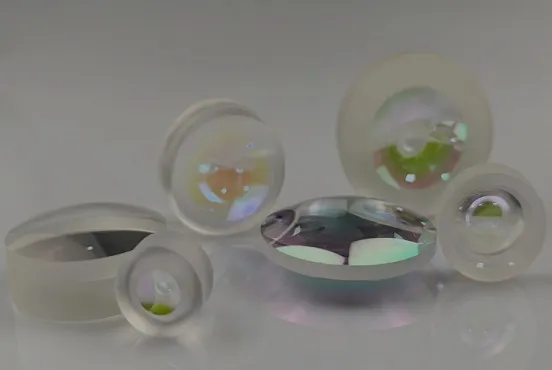
Choosing an optical material is not simply a matter of selecting the substrate with the widest transmission range. The correct material must match the operating wavelength, refractive index, dispersion, temperature range, laser power, mechanical environment, coating requirements and manufacturing budget.
N-BK7, fused silica and calcium fluoride, or CaF₂, represent three important types of optical materials. N-BK7 is a borosilicate crown optical glass, fused silica is a high-purity amorphous form of silicon dioxide, and CaF₂ is a crystalline fluoride material. Each offers a different balance of optical performance, thermal stability, durability and cost.
This guide compares N-BK7 vs fused silica vs CaF2 and explains when each material is appropriate for lenses, windows, prisms, laser optics and scientific instruments.
Choose N-BK7 for cost-effective visible glass and near-infrared optics when moderate thermal stability and standard optical performance are sufficient.
Choose fused silica when the system requires ultraviolet transmission, low thermal expansion, high optical homogeneity or improved resistance to temperature changes.
Choose CaF₂ when broad transmission from the deep ultraviolet into the infrared, very low dispersion or excimer-laser compatibility is required.
The final decision should always be based on the specific material grade, component thickness, wavelength, operating temperature and optical design.
| Property | N-BK7 | Fused Silica | CaF₂ |
|---|---|---|---|
| Optical Material Type | Borosilicate crown glass | Amorphous silica glass | Crystalline fluoride |
| Refractive Index at d-Line | 1.51680 | Approximately 1.45847 | 1.43384 |
| Abbe Number | 64.17 | Approximately 67.8 | 95.23 |
| Dispersion | Low to moderate | Low | Very low |
| Main Spectral Strength | Visible and near-infrared | UV, visible and near-infrared, depending on grade | Deep UV through infrared |
| Thermal Expansion | Approximately 7.1 ppm/K | Approximately 0.52 ppm/K | Higher than N-BK7 and fused silica |
| Relative Cost | Lower | Moderate to high | High |
| Main Advantage | Cost-effective optical quality | Thermal and UV performance | Broad transmission and very low dispersion |
| Typical Applications | General lenses, prisms and windows | UV optics, laser optics and precision instruments | Excimer lasers, spectroscopy and broadband UV-IR optics |
SCHOTT specifies an N-BK7 refractive index of 1.51680 and an Abbe number of 64.17. Corning lists a refractive index of approximately 1.45847 and an Abbe number of 67.8 for its industrial fused silica. Hellma Materials lists CaF₂ at a refractive index of 1.43384 and an Abbe number of 95.23.
These figures are useful for comparison, but optical properties can vary by material grade, wavelength, temperature and manufacturing batch.
N-BK7 is one of the most widely specified materials for general optical components. It combines good visible transmission, consistent refractive-index properties, established manufacturing processes and relatively economical raw-material costs.
Its refractive index is higher than that of fused silica and CaF₂. For the same surface geometry, this higher index generally provides greater optical power. A lens made from N-BK7 may therefore require less curvature than a lower-index material to achieve a comparable focal length.
N-BK7 also has relatively low dispersion for a crown glass, making it suitable for many monochromatic and moderate-performance broadband systems.
Common applications include:
Visible imaging lenses
Machine-vision optics
Prisms and beamsplitters
Optical windows
Laboratory instruments
Low- to moderate-power laser systems
Prototype optical assemblies
N-BK7 is normally the most practical choice when the project operates primarily in the visible range and does not require deep-UV transmission, extremely low thermal expansion or demanding high-power-laser performance.
Its limitations become more important in thermally sensitive instruments. SCHOTT lists a thermal expansion coefficient of approximately 7.1 × 10⁻⁶/K between −30°C and +70°C, which is substantially higher than that of fused silica.
Fused silica is a noncrystalline, high-purity silica material used in demanding optical and photonics systems. Compared with N-BK7, it has a lower refractive index, lower thermal expansion and strong transmission extending into the ultraviolet, although the exact spectral performance depends on the fused-silica grade.
A fused silica lens is often selected for UV imaging, laser focusing, semiconductor equipment and scientific instruments where dimensional and optical stability are more important than minimum material cost.
Corning reports a thermal expansion coefficient of approximately 0.52 ppm/K from 5°C to 35°C, compared with approximately 7.1 ppm/K for N-BK7. This low expansion helps fused silica optics maintain shape and optical performance during temperature changes.
Other advantages include:
Good optical homogeneity
Low stress birefringence in suitable grades
High softening temperature
Strong resistance to thermal shock
UV-grade and IR-grade material options
Suitability for high-precision windows, lenses and mirrors
Not all fused silica is identical. UV-grade materials may be optimized for short-wavelength transmission and resistance to UV exposure, while IR-grade fused silica may have a lower hydroxyl content to reduce infrared absorption.
The material grade must therefore be stated explicitly. Specifying only “fused silica” can lead to unexpected absorption, fluorescence, homogeneity or laser-damage performance.
Calcium fluoride is a crystalline optical material known for its wide spectral transmission and exceptionally low dispersion. Hellma Materials specifies a nominal transmission range from approximately 130 nm to 8 µm, allowing CaF₂ to support deep-UV, visible and infrared applications.
Its Abbe number of 95.23 is substantially higher than those of N-BK7 and fused silica. A higher Abbe number indicates lower visible dispersion, which can help reduce chromatic aberration in broadband imaging systems.
CaF₂ is commonly considered for:
Excimer-laser optics at 193 nm and 248 nm
UV and vacuum-UV spectroscopy
Microlithography
Broadband UV-to-infrared windows
High-power laser systems
Astronomy and scientific instruments
Cryogenic infrared imaging
Low-dispersion lens assemblies
CaF₂ can also serve as one element in an achromatic optical design because its low dispersion differs significantly from that of common optical glasses.
However, broad spectral transmission does not automatically make CaF₂ the best choice for every application. It is generally more expensive than N-BK7 and fused silica, and its mechanical and thermal behaviour requires careful consideration during component design, processing, mounting and handling.
Refractive index determines how strongly an optical material bends light. For the same lens geometry, a higher-index material generally produces greater optical power.
Among these three materials:
N-BK7 has the highest refractive index.
Fused silica has a lower refractive index.
CaF₂ has the lowest refractive index.
A lower-index material may require stronger surface curvature or greater thickness to achieve the same focal length. This can affect lens weight, edge thickness, manufacturability and spherical aberration.
Dispersion describes how refractive index changes with wavelength. It influences chromatic aberration in lenses and prisms.
CaF₂ has the lowest dispersion of the three, followed by fused silica and N-BK7. However, material selection should not be based on Abbe number alone. Optical designers must evaluate refractive index across the complete operating wavelength range using the appropriate Sellmeier coefficients or verified material data.
Thermal expansion is critical in aerospace optics, semiconductor equipment, high-power laser systems and outdoor instruments.
Fused silica provides the lowest thermal expansion of the three materials and is usually the strongest choice when dimensional stability is essential. N-BK7 provides adequate stability for many controlled indoor systems but may show greater optical and mechanical change as temperature varies.
CaF₂ offers much higher thermal conductivity than N-BK7 or fused silica, but it also has a higher coefficient of thermal expansion. Its thermal response must therefore be evaluated as a combination of expansion, heat flow, component geometry and mounting conditions. Hellma lists CaF₂ thermal conductivity at 9.71 W/(m·K), while Corning lists fused silica near 1.3 W/(m·K).
Mechanical design is equally important. Engineers should consider:
Component diameter and thickness
Surface curvature
Edge configuration
Mounting pressure
Temperature gradients
Vibration and shock
Cleaning procedures
Coating stress
Material specifications should be reviewed together with the finished optical geometry rather than as isolated catalogue values.
N-BK7 is normally the first material to evaluate. It offers established optical quality, reasonable dispersion and lower cost for lenses, prisms and windows operating primarily in the visible range.
Fused silica is usually preferred when the wavelength extends below the practical range of standard crown glass. The correct UV-grade material should be selected according to wavelength, exposure level and fluorescence requirements.
CaF₂ becomes important for shorter deep-UV and vacuum-UV wavelengths, including excimer-laser and microlithography applications.
Fused silica is generally the strongest candidate because of its very low thermal expansion. It is widely used where dimensional stability, wavefront preservation and optical homogeneity are more important than material cost.
CaF₂ offers the broadest transmission range among these three materials. It can reduce the number of substrate changes required in spectrometers and multispectral instruments.
CaF₂ can serve selected near- and mid-infrared applications, but it is not the only infrared optical materials option. Silicon, germanium, zinc selenide, zinc sulphide and sapphire may be more appropriate for specific infrared bands, thermal environments or mechanical requirements.
Use the following sequence when comparing materials for optics:
Define the operating wavelength and required transmission.
Specify the lens, window, prism or mirror geometry.
Determine the required refractive index and dispersion.
Evaluate the operating and storage temperature range.
Review laser power, pulse duration and damage requirements.
Define environmental exposure, including humidity, chemicals and radiation.
Confirm available material grade, homogeneity and inclusion quality.
Evaluate polishing, coating, mounting and inspection feasibility.
Compare prototype and production costs.
Complete an optical and mechanical tolerance review.
A material should not be selected from a transmission chart alone. The final decision must consider the complete optical assembly and its operating environment.
There is no universal winner in the comparison of N-BK7 vs fused silica vs CaF₂.
N-BK7 is the practical choice for many visible optical systems. Fused silica is preferred for UV transmission, thermal stability and precision laser optics. CaF₂ is valuable when very low dispersion or broad deep-UV-to-infrared transmission is required.
ATOPTIK supports optical material selection, component design, precision processing, coating and assembly. To evaluate a project, provide the operating wavelength, component geometry, optical tolerances, environmental conditions and expected production quantity.