English
 中文
中文 日本語
日本語 한국어
한국어 français
 Deutsch
 Español
 italiano
 русский
 português
 العربية
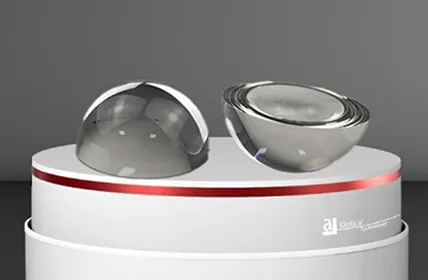
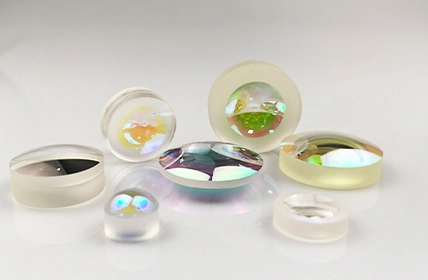
Spherical lenses are cost-effective, easy to manufacture, and suitable for general-purpose optical systems where slight aberrations are acceptable. Aspherical lenses are engineered to minimise optical aberrations, deliver superior image quality, and reduce system size and weight—making them the preferred choice for high-precision and performance-critical applications.
The right choice depends on your performance requirements, budget constraints, and system design complexity.
A spherical lens features a surface curvature that is part of a perfect sphere. This symmetry simplifies manufacturing and makes it widely available across optical applications.
An aspherical lens, by contrast, has a non-uniform curvature profile. Its surface is mathematically optimised to correct optical aberrations, especially spherical aberration, which is common in traditional lenses.
Spherical lens: Constant radius of curvature
Aspherical lens: Variable curvature across the surface
This fundamental difference directly impacts optical performance, system complexity, and cost.
Spherical lenses inherently introduce spherical aberration because light rays passing through different parts of the lens do not converge at a single focal point. Peripheral rays focus closer than paraxial rays, leading to image blur.
Aspherical lenses are designed to:
Correct spherical aberration
Reduce coma and distortion
Improve edge-to-edge sharpness
In high-end optical systems such as imaging modules, laser collimation, and medical optics, this correction significantly enhances performance.
Lower production cost
Mature manufacturing processes
Easier to polish and coat
Shorter lead times
Reduced the number of optical elements required
Compact system design
Higher optical efficiency
Superior imaging precision
In many industrial designs, engineers choose spherical lenses during early prototyping and switch to aspherical lenses once performance optimisation becomes critical.
A spherical lens is ideal when:
Cost sensitivity is high
Optical precision requirements are moderate
System size is not a major constraint
Applications include:
Basic imaging systems
Illumination optics
Educational or laboratory setups
Aspherical lenses are preferred when:
High-resolution imaging is required
System miniaturisation is critical
Optical aberrations must be minimised
Applications include:
Machine vision systems
Laser collimation and focusing
Medical and endoscopic optics
Consumer electronics (e.g., camera modules)
Not necessarily. Many optical systems achieve acceptable performance by combining multiple spherical lenses strategically. However, this increases:
System complexity
Alignment sensitivity
Total component count
Aspherical lenses can often replace multiple spherical elements, simplifying the system while improving performance.
Grinding and polishing are straightforward
High repeatability and scalability
Suitable for large-volume production
Requires advanced CNC polishing or precision moulding
Higher tooling and inspection costs
Tighter tolerances and quality control
For OEM and custom projects, selecting between these lens types often involves balancing performance targets with production feasibility.
When evaluating between spherical and aspherical lenses, consider the following factors:
Resolution
Aberration tolerance
Field of view
Size and weight limitations
Number of optical elements
Integration complexity
Prototype vs mass production
Cost per unit vs system cost
Thermal stability
Coating durability
Material selection (e.g., BK7, fused silica)
In real-world applications:
Spherical lenses are often used in cost-sensitive or less demanding systems
Aspherical lenses dominate in precision-driven industries where image quality and efficiency are critical
For example, in fibre optic coupling, a spherical lens may be sufficient for basic alignment, while an aspherical lens ensures optimal beam shaping and minimal loss.
In some cases, yes—but with trade-offs. Replacing an aspherical lens with spherical optics usually requires:
Additional lens elements
More complex system design
Reduced overall efficiency
Engineers must evaluate whether the cost savings justify the performance compromise.
Choosing between a spherical lens and an aspherical lens is not about which is universally better—it is about which aligns with your system’s priorities.
A spherical lens remains a reliable, cost-effective solution for standard optical applications, while aspherical lenses deliver unmatched performance for advanced and compact optical systems.
In precision optics manufacturing and system design, the optimal approach often involves a careful balance between performance, cost, and scalability.
Spherical lenses are widely used in imaging, illumination, and beam focusing applications where moderate optical precision is sufficient.
Their complex surface geometry requires advanced manufacturing techniques, tighter tolerances, and specialised inspection processes.
Yes. Despite the rise of aspherical optics, spherical lenses remain essential due to their affordability and versatility.
Evaluate your optical performance requirements, system constraints, and production budget. Consulting with an experienced optical manufacturer can significantly improve decision-making.
Yes. They often replace multiple spherical lenses, simplifying design and improving optical performance simultaneously.